7 min read
Six channels, zero manual entry: how a real estate agency's inquiries come in on their own
How I got inquiries from listing portals, Facebook and the website into a real estate agency's CRM on their own: no duplicates, with their property and agent.
IntegrationsAutomationBest practices
If you run a real estate agency, you know the shared inbox. Emails come in from Zonaprop, from Argenprop, from the Facebook campaigns and from the website, each in a different format. Someone copies them into a spreadsheet when they can. The same person asks through two portals and shows up twice, and another inquiry sits at the bottom until the next day. If you ask the owner how many inquiries came in this week, they can’t tell you.
The usual answer is to add someone to do the data entry, or an off-the-shelf CRM where someone still has to do it. Both leave the problem in the same place: a person copying data that already arrived in writing. My rule is different: what arrives in writing is never retyped. The system reads it, sorts it and hands it to whoever has to act.
That’s how CRM Lexinton works, the system of a real estate agency in Buenos Aires that its team of 10 users runs in production. It has processed more than 3,500 inquiries with no manual entry.
Six channels, one way in
Inquiries arrive through six channels: Zonaprop, Argenprop, forwards from Tokko Broker, Meta campaigns, the website chat and the website form. The form goes straight into the system, with the property’s code included. The other five arrive by email.
For email, the system has a reader that runs every 15 minutes. It accesses the agency’s inbox with read-only permission through the Gmail API, Google’s official way for a program to read email. It picks up from the last email it processed, and every run is logged with what it read, what it created and what it discarded.
The first thing it does with each email is recognize where it comes from. Each portal has its own reader, because each one writes differently: even the order of the subject line changes from one to the next. From each email it extracts the contact, the type of deal and the property, and it discards the noise: chatbot replies, internal emails and messages without any contact details.
There’s no artificial intelligence here, and that’s a decision. Each portal’s emails follow a fixed format, so a set of text rules gives the same result at no cost per inquiry and can be checked against real cases.
Fixed doesn’t mean forever. Starting October 21, Meta began sending its notices in a different format, and 12 sales inquiries were silently left out. Two days later the reader learned the new format, all 12 were recovered by reprocessing the emails, and an automated test with the new format keeps it from happening again.
- 01Someone asks about a listingPersonOn a portal, through a Facebook campaign or on the website.
- 02Reads the inbox every 15 minutesSystemWith read-only permission. Every run is logged.
- 03Recognizes the portal and extracts the dataSystemOne reader per portal: contact, type of deal and property.
- 04Checks whether that person already inquiredSystemBy person and property. If they were already there, it fills in the existing inquiry.
- 05Links the property and assigns the agentSystemBy listing code or by address. The agent is the one in charge of that property.
- 06The agent sees it on their listPersonWith the channel, the status and the property in view.
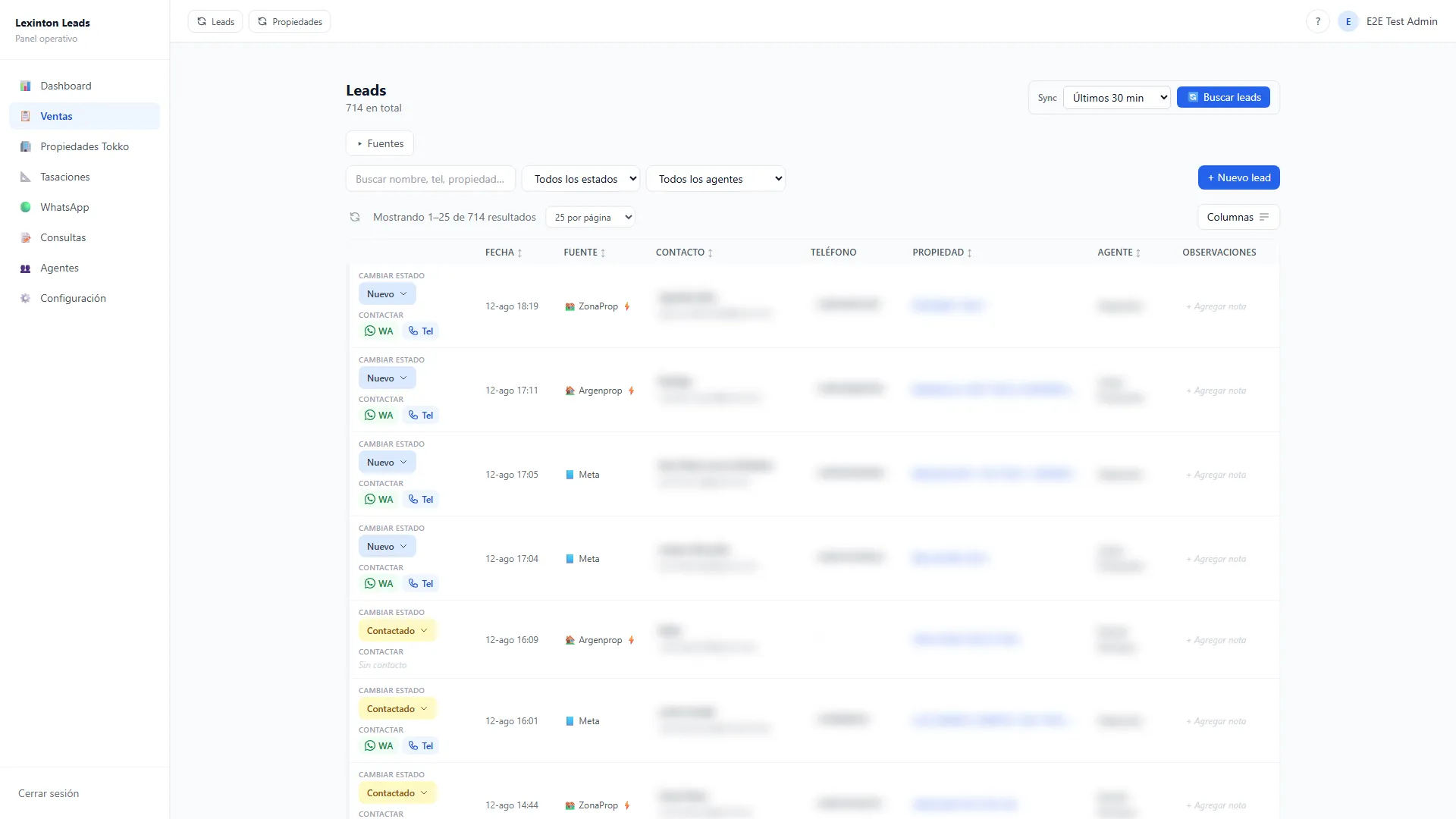
Here’s how it looks in the system’s list of inquiries.
The same person doesn’t come in twice
A prospect asks through two portals, or writes again a while later. If every email becomes a new inquiry, two agents call the same person and the owner’s numbers get inflated. That’s why, before creating anything, the system checks whether that person had already inquired:
- Same phone number or same email within two hours either way.
- Same email and same property, on the same day.
- Same phone number and same property, within 48 hours.
- The inquiry forwarded by Tokko, from the same portal and for the same property, within 48 hours.
If all of that fails, there’s one last safety net: the database rejects a repeated inquiry. And when the system finds the earlier inquiry, it neither discards nor duplicates it: it fills it in with whatever the new email brings and notes why it recognized it.
That last check came from a real error. Tokko Broker, the software where the agency manages its listings and its agents, also forwards portal inquiries by email. So the same inquiry arrived twice: straight from Zonaprop and forwarded by Tokko, with a different sender, a different subject and a different format. For a filter that compares emails, those were two inquiries. When I looked into it, there were 126 duplicate pairs over four months.
The fix was to recognize that path: a Tokko forward from the same portal, for the same property and within 48 hours, joins the inquiry that was already there and keeps the exact unit. The rule I took from it: a duplicate is recognized by the person and the property, not by the email.
Every inquiry, attached to its property
An inquiry without a property forces someone to figure out which listing it was about. To link it, you need the inventory. The agency manages it in Tokko Broker, and the system mirrors it with read-only access: listings, prices, developments and withdrawn listings.
With the inventory at hand, linking works in layers, from the safest to the most flexible:
- The listing code. The code Zonaprop publishes is the same one the property has in Tokko, so the match is exact.
- The exact address, when the email has no code.
- The approximate address, with a score, for when it’s written differently. The floor, the unit and the surface area add points.
- If two units tie, the active listing wins: a withdrawn listing never beats a live one.
The result: 98% of the inquiries that came through portals last month were linked to their property automatically, 535 of 544. Across the all-time total, 93%. The ones left unlinked are mostly general questions from the website chat or valuation requests, which don’t name a property. It isn’t a hundred, and I don’t present it as a hundred.
Inquiries linked to their property automatically
- All-time total93%
- From portals, last month535 of 54498%
The right agent, and the owner with numbers
With the property linked, what’s left is deciding who handles it. In Tokko each property has its agent in charge, and that data can change between one inventory refresh and the next. That’s why, when the inquiry is created, the system asks Tokko right then who it is. If Tokko takes longer than 8 seconds, it uses the stored value. The inquiry shows up on that agent’s list instantly.
From there, the agent changes its status with one click: new, contacted, viewing booked, closed. Every change is logged with who made it and when, and there are already 6,805. Viewings go to the agent’s Google Calendar, and the WhatsApp conversation continues in the same record, as I described in another post.
And the owner, who used to have no idea how many inquiries came in, now has a dashboard with the business in numbers: inquiries by channel, the status of each one and who is handling them.
Where to start
A simple test: take one day of inquiries and count how many times someone copied a piece of data that was already written in an email. Every copy is team time and a chance for a mistake. Then get clear on three answers:
- Which channels do your inquiries come through? All of them, including the forward nobody remembers. Each channel writes differently.
- Where does your inventory live? If it’s already in a system like Tokko, the linking comes from there.
- Who decides which agent handles each inquiry? If the rule exists, even if it’s just spoken, it can be written into the system and apply itself.
If you want your business’s inquiries to flow into your system on their own, get in touch and we’ll take a look.
Frequently asked questions
What is automatic inquiry capture in a real estate CRM?
It means every inquiry from a buyer or a tenant gets into the system without anyone copying it: the system reads the notices from the listing portals, extracts the contact and the property, and puts the inquiry on the right agent's list. In CRM Lexinton, more than 3,500 inquiries came in this way, from 6 channels.
Can Zonaprop and Argenprop be connected to a custom CRM?
Yes. The portals send each inquiry by email, and a dedicated reader for each portal turns it into a record in the system. In CRM Lexinton, the code Zonaprop publishes matches the property's code in Tokko Broker, so the inquiry is linked to its property with no room for error.
What is Tokko Broker and how does it connect to a custom system?
Tokko Broker is real estate management software where agencies manage their listings and their agents. It has an API, and a custom system can read the inventory through it. In CRM Lexinton the connection is read-only: it mirrors listings, prices, developments and withdrawn listings, and checks live which agent handles each property.
How do you avoid duplicate contacts in a CRM?
By comparing the person and the property, not the email that arrived. In CRM Lexinton, before creating an inquiry the system looks for the same phone or the same email within a short span, the same person asking about the same property on the same day or within 48 hours, and Tokko's forward of an inquiry that already came straight from the portal. Phone numbers are compared by their last 8 digits, because Argentine mobile numbers arrive with or without the 9.
What happens if the same person inquires twice or through two portals?
The system recognizes them and doesn't create a new inquiry: it fills in the existing one with whatever the new email brings. That way a prospect doesn't end up with two agents calling them, and the owner's numbers count people, not emails.
How is each inquiry assigned to the right agent?
With a rule written into the system. In CRM Lexinton, each inquiry goes to the agent in charge of the property it asks about, according to Tokko Broker. The system checks it live when the inquiry is created, because that data can change, and if Tokko takes longer than 8 seconds it uses the stored value.
Do you need artificial intelligence to read emails from listing portals?
No. Each portal's emails follow a fixed format, so text rules give the same result at no cost per inquiry and can be tested with real cases. In CRM Lexinton, the places where a language model does add value are identified separately, where the text is free-form: suggesting replies or summarizing a conversation.
How often do portal inquiries reach the CRM?
In CRM Lexinton, the email reader runs every 15 minutes and every run is logged. The website form doesn't wait: it goes straight into the system with the property's code. As soon as the inquiry is created, it shows up on the agent's list.
What share of inquiries can be linked to a property automatically?
It depends on what the inquiries include. In CRM Lexinton, 98% of last month's portal inquiries were linked automatically, 535 of 544, and 93% of the all-time total. The ones left out are mostly general questions from the website chat or valuation requests, which don't name a property.