6 min read
The top seller isn't pizza: the first two weeks of a delivery app
I measured the first two weeks of Zizu with real orders: what people order, when, how long it takes and what I fixed. What to look at when your system goes live.
Best practicesEvaluationIntegrations
Sunday, five in the afternoon, in a small city in Buenos Aires Province. Someone opens an app and orders a dozen pastries. Half an hour later the doorbell rings. That scene, and not the pizza at ten at night, is the one that repeated most in the first two weeks of Zizu with real orders.
When a system goes live, the usual move is to breathe out and move on to the next thing. My rule is different: the first two weeks get measured, because that’s when the system tells you what product you built. Here is what the Zizu numbers said, in percentages, and what I changed because I looked.
In a small city, delivery is the afternoon snack
Zizu is the delivery platform of General Villegas, in production at zizu.com.ar: the customer orders, the shop prepares and a courier delivers. One app for shops in 16 categories, paid in cash or with Mercado Pago.
Anyone would have bet on pizza and burgers. Delivered orders say otherwise: pastry shops and bakeries add up to 57%. Pizzerias, under 4%.
Delivered orders by category
- Pastry shops31.8%
- Bakeries24.8%
- Delis, ice cream shops and cafes7% each category21.0%
- Sandwiches and quick meals5.7%
- Pasta3.8%
- Pizzerias3.8%
- Other categoriesGrocery, butcher, pharmacy and pet shops, among others8.9%
No single shop takes the market either. The top seller made 15% of orders, the second 8% and the third 7%. For a platform that serves a whole city, that spread is worth more than one star shop.
Two peaks, and one is at five in the afternoon
The schedule confirms the story. The afternoon snack, between 4 PM and 7 PM, concentrates 26% of delivered orders, peaking at 5 PM. The night, from 9 PM to midnight, 28%. And there are orders from 8 AM to 2 AM.
Delivered orders by time slot
- Morning, 8 AM to 12 PM15.9%
- Midday, 12 PM to 4 PM17.2%
- Afternoon snack, 4 PM to 7 PMPeak at 5 PM26.1%
- Evening, 7 PM to 9 PM8.9%
- Night, 9 PM to 12 AM28.0%
- Late night, 12 AM to 3 AM3.8%
That changes who you design for. At five in the afternoon the shop is serving the counter, often with a computer next to it and several tabs open. So when an order comes in, the shop screen rings, blinks and changes the tab title: it’s the only thing visible from the register.
33 minutes, stage by stage
From order to doorstep takes a median of 33 minutes, meaning half of the orders take less. Nine out of ten arrive in under an hour. I also measured the median of each stage:
- 3 minutes until the shop accepts.
- 4 minutes until it’s ready. Much of it is already made.
- 11 minutes until a courier picks it up.
- 8 minutes of travel to the door.
The longest stage is the wait for a courier. That’s where the next improvement is, and I know it because it’s measured.
Other numbers that set priorities:
- 74% of orders were delivered. Of the canceled ones, 7 out of 10 were canceled by the customer, all before the shop accepted. Nobody prepared anything for nothing. Shops rejected 3%.
- 54% were paid with Mercado Pago and 46% in cash. An online-only app would have left out almost half.
- 34% of customers ordered again within the same two weeks.
- 38% of delivered orders have a review, averaging 4.77 out of 5.
The order someone else had already taken
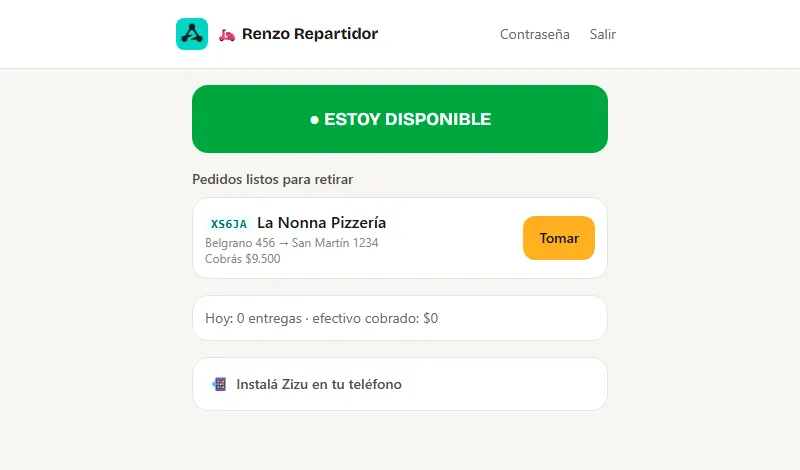
One moment is worth telling. In a test with several couriers at once, when one took an order, the others kept seeing it on their list for up to 3 minutes. They tapped Take on an order that was no longer there.
The cause was half good news. Zizu announces every change in real time, and the database applies permissions to every update: a courier can only read ready orders that don’t have a courier yet. When someone else takes it, that order is no longer theirs to read, so the update about the change never reaches them either. Security worked so well it hid the news.
The easy fix was to open up permissions so everyone could see the change. That would have exposed addresses and phone numbers from other people’s orders. I did something else: when an order leaves the queue, the database itself sends a minimal message over a separate channel.
Travels in the message
The minimum
- The number of the order that left the queue
- Only to the active couriers in that city
- Sent by the database, nobody from outside
Never leaves the database
The private part
- The delivery address
- The customer phone number
- The order details and amount
And if that message failed, taking the order works the same and the list corrects itself on the next refresh. Real time is the fast lane, not the only one.
For the technical side: Supabase Realtime applies RLS, PostgreSQL row-level security, to every change it transmits. The fix is a trigger that emits a Broadcast over a private channel per city, with read-only permission for active couriers. Everything travels over a single websocket per phone, and each screen listens only to its own order, shop or city.
One complaint, one day
The other fix came from customers. They searched for “milanesa”, a breaded cutlet, and nothing came up, because search only looked at shop names. Now it searches the product, its description and the menu section, ignoring accents, and “milanesa” returns 27 products from 7 shops. It shipped in one day.
That pace is possible because each change is first written as a rule with concrete examples, then comes the test that checks it, and only then the code. Zizu has 137 database changes, all versioned, and every product rule has its own automated end-to-end test. Fixing fast without breaking what works is a consequence of that.
What to look at in your system’s first two weeks
It applies to a delivery app and to any system that just went live. Four questions are enough:
- What actually gets used? What you imagined and what happens rarely match. On Zizu it was the afternoon snack.
- Where does the time go? Measure each stage separately. The overall average doesn’t say where to improve.
- Who cancels, and when? A customer canceling before anyone does any work is very different from a rejection. Record who did it.
- How long does a complaint take to become an improvement? If the answer is weeks, what’s missing is automated tests.
If you’re about to launch a system, or you already have one running and want to know what it’s telling you, message me and we’ll look at it together.
Frequently asked questions
Does a delivery app work in a small city?
Yes, if it adapts to how that city shops. In the first two weeks of Zizu with real orders, 34% of customers ordered again and reviews averaged 4.77 out of 5. What changes compared to a big city is what people order and how they pay, and you find that out by measuring.
What do people order most on a delivery app in a small city?
On Zizu, the top categories are pastry shops and bakeries: together they account for 57% of delivered orders in the first two weeks. Pizzerias came in under 4%. The schedule matches: one of the two strongest time slots is the afternoon snack, between 4 PM and 7 PM.
How long does a delivery order take to arrive?
On Zizu, the median from order to doorstep is 33 minutes, and 9 out of 10 orders arrive in under an hour. The longest stage is the wait until a courier picks up the order, with a median of 11 minutes. Measuring each stage separately shows where to improve.
Should a delivery app accept cash?
Yes, especially in small cities. On Zizu, 54% of delivered orders were paid with Mercado Pago and 46% in cash. An app that only took online payments would have left out almost half of the orders.
Why do orders get canceled on a delivery app?
Most are canceled by the customer right after placing them. On Zizu, 7 out of 10 cancellations came from the customer, all of them before the shop accepted the order, so nobody prepared anything for nothing. Shops rejected 3% of orders. Every cancellation records who made it: the customer, the shop, the admin team or the system.
What does real time mean in an app?
It means a screen learns about a change the moment it happens, without reloading. In a delivery app, the customer watches the order move forward, the shop hears the alert for a new order and the courier sees the orders ready for pickup. It's worth adding a periodic refresh as a backup, so the screen corrects itself if an update is lost.
How does Supabase Realtime work with row-level security (RLS)?
Supabase Realtime applies PostgreSQL row-level security to every update: each user receives only the changes to rows they can read. That protects the data, but it has a consequence: if a row stops being visible to someone, the update about that change never reaches them. On Zizu I solved it with a trigger that sends a minimal message over a private channel, without loosening permissions.
What metrics should I look at after launching an app?
The ones that describe real usage: what gets used, at what time, how long each step takes, who cancels and how many come back. On Zizu I measured orders by category and by time slot, the median of each delivery stage, cancellations with their author, and repeat orders. That lets you decide what to improve first with data instead of guesses.
How do you fix a live system quickly without breaking what already works?
With automated tests that cover every product rule. On Zizu, each change is first written as a rule with concrete examples, then comes the test, and only then the code. That's how a search improvement requested by customers shipped in one day, with the rest of the system verified.
Do I need to publish an app in the app stores to run my own delivery service?
Not necessarily. Zizu is a PWA, a web app that installs on the phone's home screen straight from the browser, without going through an app store. Customers, shops and couriers use the same address, and every update reaches all of them at the same time.